
A unified, outcomes-based foundation designed to help every Pitt undergraduate develop the knowledge, skills, and habits of mind to thrive — in their major, their career, and their communities.
What is the General Education Reform Initiative?
Since January 2024, the General Education Reform Task Force has been collaborating with Pitt faculty, students, staff, and alumni to redesign how foundational learning is structured for all undergraduate students.
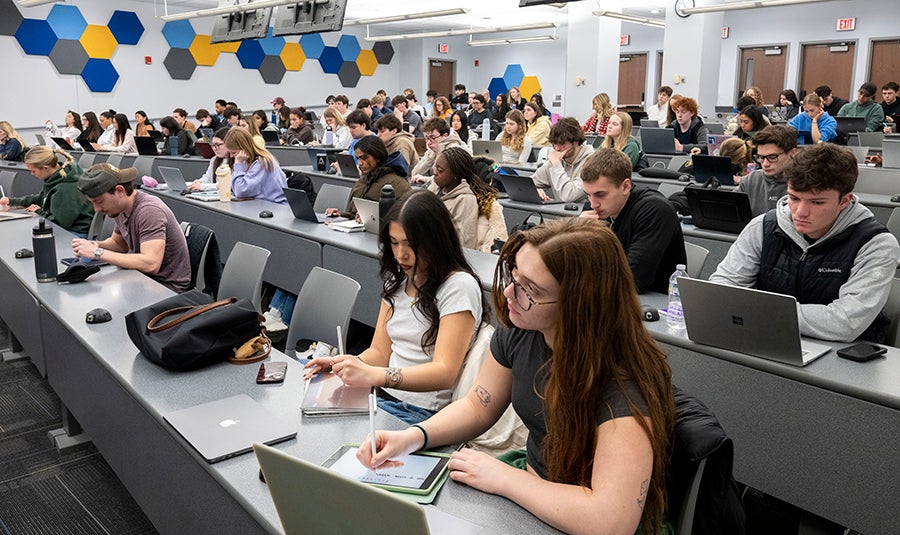
The goal by Fall 2027 is to replace nine separate general education curricula—each managed independently by individual schools and campuses—with one unified, University-wide program.
This new curriculum, currently under review by academic leaders, will make it clearer to students why general education matters, how it connects to their major, and what they are learning and building along the way.
Rather than a checklist of requirements to "get out of the way," it is designed to be the intellectual foundation for everything that follows.
Why is Pitt reforming general education?

The world students are entering is changing rapidly—and Pitt's curricular structures need to keep pace. Today's employers and graduate programs expect graduates who can collaborate across disciplines, communicate clearly, reason with data, and adapt to new challenges.
At the same time, students want coursework that connects to real-world problems and their own goals.
Pitt's current model—nine separate general education requirements across schools and campuses—makes it difficult to articulate shared learning goals, assess program effectiveness, or support students who transfer between campuses or pursue multiple credentials.
The reform addresses these gaps while honoring the academic autonomy and disciplinary strengths of each school.
More than 3,000 students responded to surveys and 16 listening sessions were held during Phase 1. Across all groups, students consistently cited a desire for courses that help them become "more well-rounded" and connected to real-world challenges.
What does this mean for students?
The reformed program is built around four broad learning goals—each grounded in the skills, perspectives, and competencies that students need for personal and professional success.
Students will be able to see how their coursework connects to these goals and articulate what they've learned to employers, graduate programs, and the broader world.
The Four Learning Goals
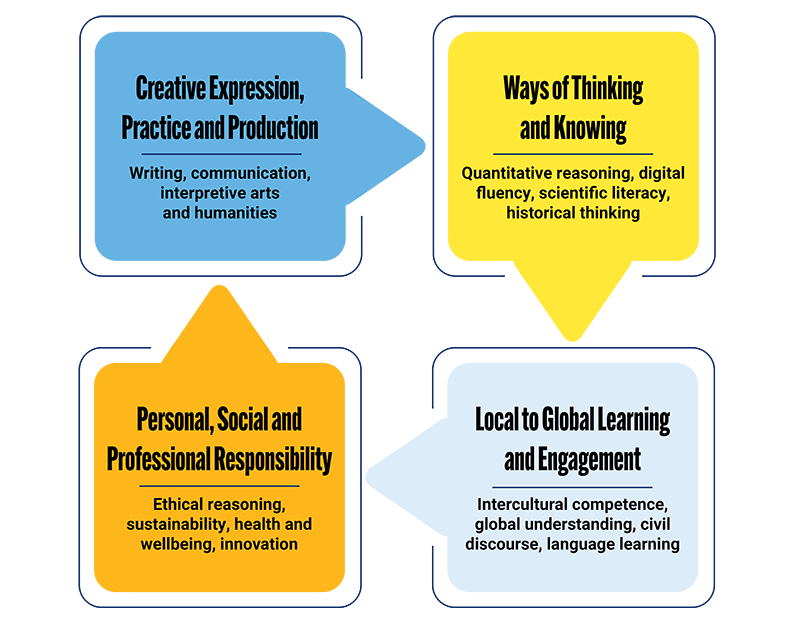
- Creative Expression, Practice and Production — Writing, communication, interpretive arts and humanities
- Ways of Thinking and Knowing — Quantitative reasoning, digital fluency, scientific literacy, historical thinking
- Local to Global Learning and Engagement — Intercultural competence, global understanding, civil discourse, language learning
- Personal, Social and Professional Responsibility — Ethical reasoning, sustainability, health and wellbeing, innovation
In addition, students can expect:

More flexibility: Courses will be designed to double-count across requirements, reducing redundancy and giving students more room to pursue minors, certificates, and dual degrees.
Meaningful credentials: Students will have opportunities to earn micro-credentials (Interdisciplinary Distinctions) that appear on their transcript and showcase learning in areas like innovation, health, and emerging technologies.
Real-world learning: Experiential learning—including internships, undergraduate research, community-engaged learning, and study abroad—will be more intentionally integrated into the curriculum and made more equitably accessible.
Better advising: Advisors across all campuses will be trained and equipped with clear, consistent tools to help students navigate the new curriculum and build a personalized path through their foundational requirements.
Learn more about The Proposed Curriculum »
Timing: What we've accomplished and what comes next
- PHASE 1 - 2024: Listening and Benchmarking
The Task Force completed 16 listening sessions, gathered 3,000+ student survey responses, and benchmarked 12 peer institutions to identify key trends and priorities for reform.
- PHASE 2 - 2025: Drafting and Community Engagement
The Task Force shared draft prototypes — including learning goals, outcomes, and curricular structures — for broad input through Drafting Days, targeted sessions with content experts, and an online feedback form, engaging 624 participants across 30 sessions.
- PHASE 3 - SPRING 2026 - Framework Review and Implementation Planning
The framework is being shared with academic leaders for review and comment. Project teams are developing detailed implementation plans covering advising, assessment, experiential learning, faculty development, and marketing and communications.
- SUMMER 2026: Implementation Plan Released
A comprehensive Implementation Plan will be shared with senior leadership in June and finalized for approval by August 2026, including the formation of new curriculum and assessment committees.
- FALL 2027 - TARGET - New Curriculum Launches
The goal is for the new unified general education curriculum to go into effect for incoming students beginning in Fall 2027, pending approvals and collaboration with schools and campuses.
Note: As the University works toward a Fall 2027 program launch, the new General Education curriculum will be open exclusively to incoming first-year or transfer students in term 2281 and thereafter.
Continuing students—sophomores, juniors, and seniors enrolled prior to Fall 2027—may complete existing general education requirements at the discretion of their home school or campus through exceptions processes developed by dean’s offices.
This approach will allow advisors, faculty, and the General Education Task Force to manage the transition thoughtfully, identify and address implementation challenges at a manageable scale, and ensure that all students—whether on the new or legacy curriculum—receive consistent, high-quality advising and support throughout the transition period.
Questions?
Email the Gen Ed Task Force at generaled@pitt.edu.
Or learn more about the work of the task force at General Education Reform Task Force.