
To streamline the student experience, boost student success, and align with the Plan for Pitt, the University of Pittsburgh is implementing, over the course of the next few academic years, to a shared model of advising on the Pittsburgh campus. We are working more intentionally with each academic unit to standardize collaborative and holistic advising practices for every student.
The Plan for Pitt 2028 values are “defined by excellence and focused on elevating our community’s aspirations.” Under the first pillar, where we will cultivate student success, a key initiative is to amplify the Pitt ACT (Advisor Certification and Training) Program, with a specific call-out to Enhancing Student Support Services in order to Improve retention rates, graduation rates, and post-graduate success.
What is a shared advising model? A shared model has a central administrative unit (the Student Success team) that provides supervision, oversight, coordination, and support (including to at-promise and exploratory student populations), while students are advised in their respective academic units (Pardee, 2004).
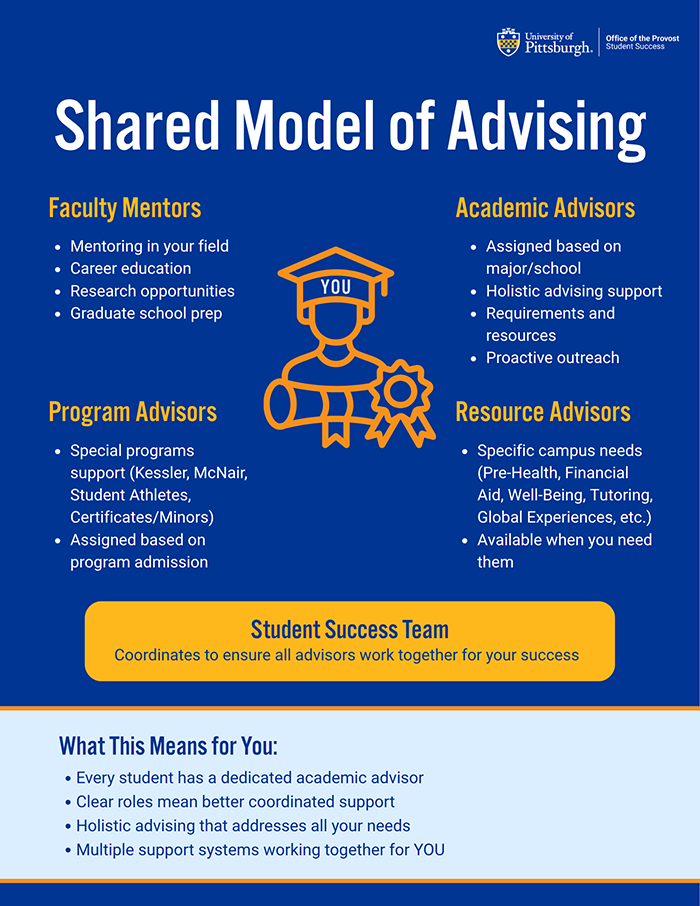
In the shared academic advising model, advising roles are also more clearly defined:
- Professional staff academic advisors have formally assigned student rosters based on their major, college, or school. All undergraduate students will have a dedicated, assigned academic advisor who is knowledgeable about requirements and resources. They will proactively provide holistic advising and implement the “Big 5” standard interventions coordinated from the Office of the Provost.
- Faculty mentors work with students based on their major, college, or school to provide mentoring for opportunities such as career education, graduate school preparation, internships, and research.
- Program advisors work with students based on their formal participation in a program (not based on a major, college, or school). These supplementary advisors are also formally assigned in the student’s record. Some examples may include Provost Scholars, Kessler Scholars, Education Outreach Center (EOC) Students, McNair Scholars, Academic Support Services for Student Athletes, Study Abroad, BRIDGES.
- Resource advisors work with students to fulfill a specific need on campus but are not assigned on the student’s record. Some examples may include Pre-Health Resource Center, Financial Aid or Well-Being, Tutoring.
What this means for you:
- Every student has a dedicated academic advisor
- Clear roles mean better coordinated support
- Holistic advising that addresses all your needs
- Multiple support systems working together for YOU