
Universities are in the business of helping people learn. But how well do universities themselves learn?
How do we get smarter, as an institution, about supporting students—especially those who face the greatest barriers to success? That question drives Pitt’s investment in Action Research: a disciplined approach to institutional learning where research and practice inform each other continuously, and where what we discover in one corner of campus travels to everyone who can use it.
Pitt already does extraordinary work to support students. We have talented advisors, committed faculty, and programs that change lives. But that work often happens in isolation. One team tries something new, learns from it, and that knowledge stays local. Another team faces a similar challenge, starts from scratch, and we’ve lost time and insight. It’s not a failure of effort or commitment. It’s a gap in coordination. We lack the connective tissue that lets us learn together.
Action Research provides that connective tissue.
The Action Research Cycle
Developed by social psychologist Kurt Lewin, Action Research follows a cycle: Plan, Act, Observe, Reflect. Each cycle deepens understanding and refines practice. Rather than separating research from the daily work of supporting students, Action Research treats them as inseparable: we learn by doing, and we improve by reflecting on what we’ve done.
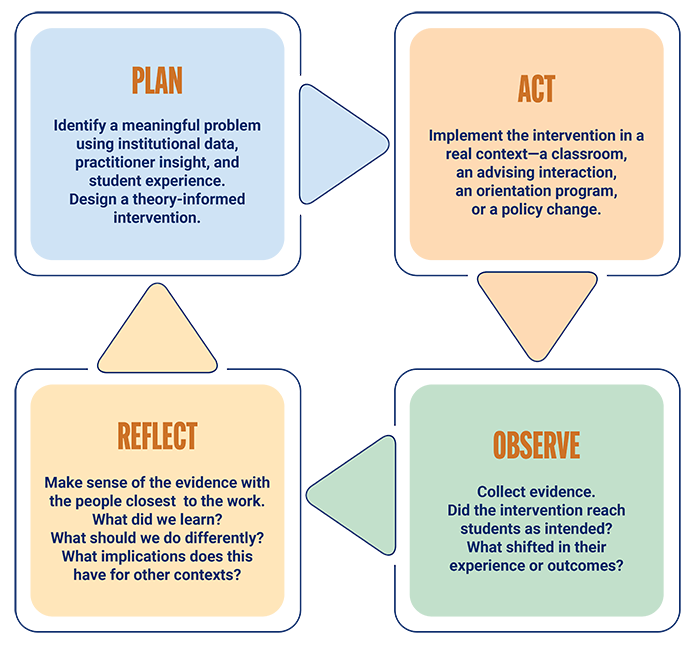
- Plan: Identify a meaningful problem using institutional data, practitioner insight, and student experience. Design a theory-informed intervention.
- Act: Implement the intervention in a real context—a classroom, an advising interaction, an orientation program, or a policy change.
- Observe: Collect evidence. Did the intervention reach students as intended? What shifted in their experience or outcomes?
- Reflect: Make sense of the evidence with the people closest to the work. What did we learn? What should we do differently? What implications does this have for other contexts?
Five Priority Areas
Our work is organized around five domains where coordinated inquiry can have immediate institutional value:
- Psychology of Student Success: Understanding and applying the psychological mechanisms—belonging, motivation, mindset, stress—that shape how students engage, persist, and thrive.
- Teaching and Curricular Innovation: Partnering with academic units to examine how curriculum design, course structures, and pedagogical approaches support student outcomes.
- AI in Student Success: Evaluating how AI tools and technologies can responsibly enhance advising, learning, and early intervention efforts.
- Advising Innovation: Strengthening advising practice through research partnerships that test new approaches and build shared knowledge across advising units.
- Graduate Student Experience: Investigating the distinct challenges graduate students face in persistence, progression, and well-being, and developing interventions tailored to graduate contexts.