
Background
Access to higher education is a significant priority for the University of Pittsburgh, especially in support of our at-promise student populations.
We also know it is imperative to prioritize undergraduate student retention, persistence, and graduation outcomes, and students need an ongoing, integrated approach to student support (Stebleton & Soria, 2012).
With these goals in mind, the Student Success team has developed a framework for institutional student success to guide decision-making and practice, and includes foundational elements towards coordination with the colleges, schools, and campuses.
Plan for Pitt 2028
The first pillar in the Plan for Pitt is “we will cultivate student success” and guides the framework by indicating that “By engaging in intentional planning and purposeful programming, we aim to make the Pitt experience exceptional, from the moment a student first steps on campus through their postgraduation journey.”
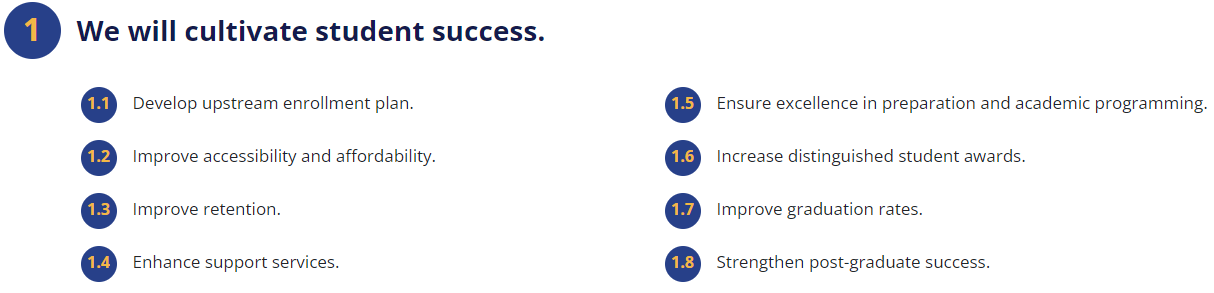
Click the image above to visit the Plan for Pitt 2028 Values webpage.
The following items support this pillar:
- 1.1 Develop upstream enrollment plan.
- 1.2 Improve accessibility and affordability.
- 1.3 Improve retention.
- 1.4 Enhance support services.
- 1.5 Ensure excellence in preparation and academic programming.
- 1.6 Increase distinguished student awards.
- 1.7 Improve graduation rates.
- 1.8 Strengthen postgraduate success.
Student Success Objectives
In support of the Plan for Pitt, the following institutional student success objectives guide the work:
- Consistently boost institutional persistence, retention, and graduation rates by identifying gaps within our at-promise student populations.
- Create holistic advising interactions for every Pitt student every semester.
- Improve student engagement in academic resources and programs.
- Expand students’ academic success skills and leadership opportunities.
- Offer more interdisciplinary and co-curricular experiences to provide opportunities which translate knowledge into practical applications.
- Increase long-term career outcomes by identifying gaps within our at-promise student and alumni populations.
- Ensure a sense of belonging for all Pitt students.
Approach
We have developed a future-forward approach to student success that portrays what was in the past (on the left) and what is now (on the right) focused on an asset-based, student-centered, and holistic view.
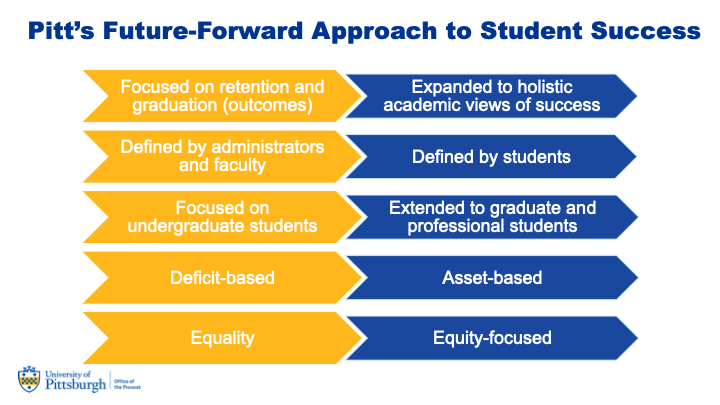
In terms of past to present, the approaches span:
- Focused on retention and graduation (outcomes) to Expanded to holistic academic views of success
- Defined by administrators and faculty to Defined by students
- Focused on undergraduate students to Extended to graduate and professional students
- Deficit-based to Asset- based
- Equality to Equity-focused
This is guided by an institutional collaborative effort, including feedback from college, school, and campus partners, administration, and students.