
The Advising Coordination Project employs a collective impact approach to align and enhance the various advising and student success support systems across the University of Pittsburgh. A collective impact approach manifests shared goals and leverages common datasets, tools, and assessments.
This is a new approach, not new work. Employing this framework does not mean creating new work for those aspiring to make advising more collaborative and holistic. Instead, we aim to take current individual actions and isolated impacts and make them work in a more coordinated way.
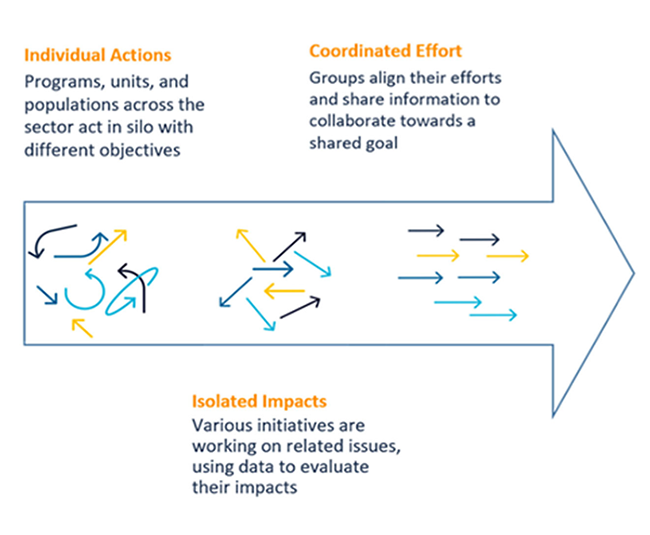
Image from UC San Diego (2023). Collective Impact. Regents of the University of California.
In a coordinated effort such as a collective impact approach, groups align their efforts and share information to collaborate toward a shared goal. This is in contrast to individual actions, in which programs, units, and populations across the sector act in silos with different objectives, and isolated impacts, where various initiatives are working on related issues using data to evaluate their impacts.
There are five strategies toward collective impact, for which the advising coordination project is committed:
- Common agenda
- Shared measurement
- Mutually reinforcing activities
- Continuous communication
- Strong backbone
Assessment
Toward this goal, we work together on establishing a shared measurement to track progress in the same way, allowing for continuous learning and accountability. The main objective of the advising coordination project is to “streamline the student experience and boost student success measures.” Aligned with the Plan for Pitt, we have also developed an institutional framework for student success, which includes specific objectives to guide the assessment of the project.
Each academic year, individual academic units identify goals that align with a collective objective (identified by the Office of the Provost), and we assess our progress on how we meet this objective. For the 2025-2026 academic year, we are focused on the following collective objective:
- Consistently boost institutional persistence, retention, and graduation rates by identifying gaps within our at-promise student populations.
References
- UC San Diego (2023). Collective Impact. Regents of the University of California
- Collective Impact Forum. What Is Collective Impact?