
At the University of Pittsburgh, advising, mentoring, and coaching are integral to the University’s educational mission as we provide a system of academic support through a shared model of advising for undergraduate students. Within the Advising Coordination Project, faculty mentoring plays a key role in that structure.
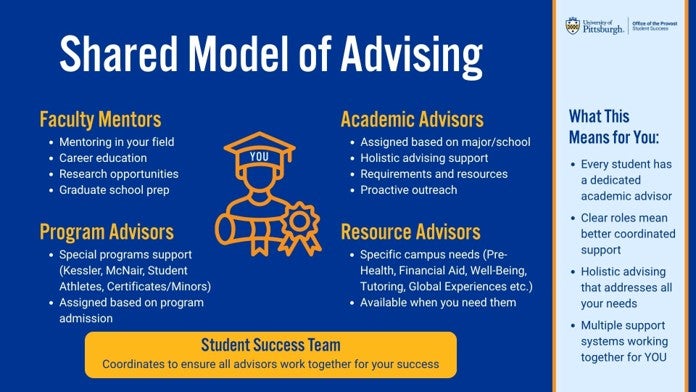
Across our undergraduate colleges and schools, faculty have always supported students outside the classroom as they explore disciplines, discern career pathways, engage in research, lead a club, and or seek personal guidance. The role of faculty mentoring is guided by the following:
- Goal: The elevation of the role of faculty mentors becomes additive and is accompanied by enhanced infrastructure and support for student-facing faculty across schools to increase student connections and enable engagement in the high-impact mentoring activities unique to the faculty role.
- Definition: Faculty mentoring is the personal engagement of students by faculty outside the classroom to foster students' personal, academic, and professional development. This includes mentoring in discipline-specific and field-related topics, career education, graduate school preparation, or engagement in high-impact practices such as undergraduate research, internships or experiential learning.
- Guiding Principles:
This page explains where the faculty mentoring initiative came from, what we've learned so far, the questions and concerns raised along the way, and what comes next.
Background
Work to define Faculty Mentoring at Pitt began in earnest in summer 2025, in connection with the university's move toward Shared-Advising. David Sanchez, appointed as a Provost Faculty Fellow, began a listening tour across the University by interviewing individual faculty, program directors, advisors, and school leadership from Dietrich School of Arts and Sciences, Swanson School of Engineering, the Business school, the School of Health and Rehabilitation Sciences, the School of Computing and Information, the School of Public Health, the School of Education, the School of Nursing, and the Frederick Honors College. These were chosen based on the phased-approach for Shared-Advising implementation.
These conversations surfaced many of the different forms faculty mentoring already takes at Pitt, the experience, intuition, and long-standing relationships faculty bring to the student experience, and the ways that students often experience faculty as a "one-stop shop" for solving problems that don't fit neatly into an advising office.
That groundwork led to two University-wide workshops:
Workshop 1: November 2025: Discussing and Developing the Faculty Role in a Shared-Advising Model. This workshop brought together faculty stakeholders and school leadership (including Associate Deans) to talk through what current and anticipated challenges for faculty mentoring look like across Pitt. The clearest takeaway: the university, and specifically each school, needs clear roles and responsibilities for faculty mentors, staff advisors, and Directors of Undergraduate Studies (DUGS).
Workshop 2: March 2026: Discussing Roles and Collaboration in Shared-Advising. This session expanded participation to Faculty, Program Directors, Directors of Advising, Associate Deans, and Advisors, and focused on where roles overlap and where tension exists. A major takeaway was a desire to understand how mentoring efforts would be accounted for, how student-faculty interactions would be maintained, and how interactions would be coordinated and managed.
Following the second workshop, Provost Faculty leadership met individually with each school between May and July 2026 — Nursing, Business, Public Health, Education, SHRS, Swanson, and DSAS to talk through how Faculty Mentoring could take shape within each school's existing advising structure.
What We've Learned So Far
Feedback from interviews, workshops, and school meetings clusters around three recurring themes.
1. Role Clarity, Responsibility, and Trust
The single most consistent takeaway is that as a community, we are in the early stages of defining faculty mentoring and staff advising roles including how we outline individual and shared responsibilities while being cognizant of school- and program-specific contexts. As we move forward, it will be important to identify and incorporate best practices, recognizing all for their expertise and commitment, and create teams and policies that optimize student support and center trust and respect.
2. Structure and Workload
Faculty and advisors alike raised real concerns about how this work is supported. The differences between schools (disciplinary requirements, structure of the curriculum, faculty: student ratio, etc.) are important for school-level leadership to consider as they develop the focus of faculty mentors, the number of faculty mentors needed, and how these roles are expected to operate within the shared-advising model. It is especially important to consider how faculty mentor workloads should adapt to growing student enrollments, developing workload policies and the faculty mentoring training that will be instituted at the university-level.
3. Communication and Trust Between Roles
The success of this endeavor rests significantly on assembling shared-advising teams and policies that understand the strengths and perspectives of each member and build trust between academic advisors, program advisors, resource advisors, faculty mentors, and students. Building this culture and network of “best experts” will require a significant amount of communication within schools and across the University and will take some time. Consequently, developing a community of practice and this culture of communication and trust will be a critical focus of the University-wide subcommittee on Faculty Mentoring.
What's Next
Two major, related efforts are moving forward:
1. Supporting and Elevating Faculty Mentoring
We are organizing formal training for Faculty Mentors in two complementary formats:
Asynchronous, online Introductory modules (via Canvas) which will be a quick, self-paced way for faculty, especially those new to Pitt, to get oriented to:
- Understanding the impact of Faculty Mentors on student experiences
- Introducing CIMER and the foundations of effective mentoring
- Accessing university resources for student support and well-being
- Connecting to university systems, (Pathways Documentation/Referrals)
- Discovering partners and programs across Pitt that can extend your mentoring reach
In-person training sessions will be designed to bring faculty mentors together to:
- Complete Foundations of Undergraduate Mentoring (CIMER training for those who have not already completed a similar Mentor training here at Pitt)
2. Building the Infrastructure Around Faculty Mentoring
- Community of Practice: there will be gatherings every semester that will be guided and supported by the University-committee on Faculty Mentoring (this is subcommittee to the UUAC). These gatherings will be used to build personal connections with other mentors, and program and resource staff across Pitt while sharing best practices and resources across programs and schools.
- Supporting faculty, departments, and school leadership as they delineate and integrate the Faculty Mentor role within their advising frameworks, including:
- Presentations on Faculty Mentoring at Pitt for departments and schools
- Developing Training for managing Faculty Mentoring and for school leadership (i.e. Chairs)
- Development of evaluation schemes for Faculty Mentoring, so this work is formally recognized.
Frequently Asked Questions
- Q: Why is Pitt introducing a delineation between "Faculty Mentoring" and “Academic Advising”?
Faculty mentoring is meant to increase capacity for the kind of mentoring activities we already know make a difference for students. Its coordination with the Shared-Advising framework is intended to also help with existing challenges: supporting transfer students and non-linear degree paths, students juggling multiple majors, delays in graduation etc.
- Q: What exactly does a Faculty Mentor do, versus a staff advisor?
This is one of the most common questions raised in every workshop, and it's a top priority. In general, faculty are best positioned to own the substance of a student's academic experience; the curriculum, degree requirements, program-specific guidance, exploring careers in depth, and supervising independent studies or research. Staff academic advisors are central to navigating university systems, requirements, general education curricula, opportunities outside of a student’s department or field, and overall logistics. The next step is to work with each school to create more defined roles of faculty mentoring using the definition, goal, and principles above.
- Q: Who trains staff advisors in discipline-specific knowledge, since they aren't expected to have it?
Right now, faculty and program directors are helping, but workshop participants flagged it as a potential gap for schools who have not had staff advising. Ultimately, this is about ensuring advisors learn about the discipline but more importantly can refer students to Faculty Mentors for guidance that falls outside their expertise. Addressing this gap is a direct driver behind creating strong referral pathways between advisors and faculty mentors and building faculty mentor training that ensure faculty are a key part of these shared processes.
- Q: How will "faculty mentoring" actually count toward workload, service, or promotion?
One thing that has emerged clearly from our engagements to date is that the substance and practice of faculty mentoring varies across schools and disciplines. As such, this question must necessarily be answered within academic units rather than universally. It is important to note that each school is being requested to more formally recognize faculty mentoring and consider these activities within their broader workload discussions.
- Q: How do we actually get students to meet with their faculty mentors?
This was raised several times as a core challenge for some schools. Ideas discussed include required touchpoints during student milestones, clearer communication to students about what a faculty mentor offers, and how that's different from an advisor, and better integration between advising check-ins and mentor engagement. This is an active area of design as different models have been used across schools and current approaches look different depending on each school's curricular and administrative structure.
Q: Won't requiring meetings with both a faculty mentor and an advisor create extra burden, especially for students who already need the most support?This equity concern was raised. The goal is not to double the number of required meetings for students who are already stretched thin, but to make sure the right person is meeting with a student at the right time which is exactly why clearer role definitions and referral practices between advisors and faculty mentors matter. Future student meeting requirements and the coordination between roles will need to be designed with this concern in mind.
- Q: Struggling students seem to fall in the gap between advisors, DUGS, and faculty mentors. Whose responsibility is that?
Every group in these workshops DUGS, advisors, and faculty mentors identified supporting struggling students as a shared responsibility. No single role owns this alone, and part of the intent of clearer role definitions is to make sure students in difficulty are consistently caught, not lost between roles.
- Q: Will resources or support for faculty be cut as this rolls out?
The explicit, stated goal of this transition is that it be additive: existing resources and support for faculty in student-facing roles should not be reduced but rather better focused to further support the work faculty are already doing.
- Q: What if I’ve already completed CIMER training or the Foundations of Graduate Mentoring course?
If you’ve completed CIMER training for mentoring, either through their school or through the Center for Mentoring, you don’t need to repeat it. We invite you to join our community of practice focused on mentoring undergraduate students where you can build on what you’ve learned and connect with colleagues doing similar work
- Q: What training will faculty mentors actually receive, and when?
Two forms of training are being developed to meet the needs surfaced in our faculty engagements to date. An asynchronous, self-paced set of online modules (delivered via Canvas) will cover the impact of faculty mentoring, the general layout of faculty mentoring at Pitt, and connect faculty to university systems and resources like Pathways, well-being services, and other programs. In-person training will focus on developing the CIMER mentoring core competencies. Lastly, we intend to complement this by bringing faculty mentors together across schools as a community of practice to build personal connections, share best practices, build resources, and connect with program and resource advisors.
- Q: How can I learn more, get involved, or ask questions?
School-level meetings have already taken place with Nursing, Business, Public Health, Education, SHRS, Swanson, and DSAS. If your school has questions or wants to shape how Faculty Mentoring is implemented locally, reach out to both David Sanchez (davidsanchez@pitt.edu) and your school's Associate Dean or Director of Advising, who have been part of these conversations. Upcoming workshops and additional engagement opportunities will be posted here and sent out to Associate Deans.
This page reflects a work in progress. Faculty Mentoring at Pitt is being defined collaboratively, and this content will be updated as training programs, and school-level frameworks develop. If you have questions, comments or concerns please reach out directly to David Sanchez (davidsanchez@pitt.edu),