
Status: COMPLETED
Priority Area: Psychology of Student Success
Population: First-generation, limited-income, and underrepresented minority undergraduates
Delivery: Cohort-based student support programs (TRIO SSS, RISE, BRIDGES, Provost Academy)
Mechanism: Mentoring, community building, holistic support, belonging
Overview
The Program Impact Evaluation is a research initiative aimed at understanding the landscape of support for first-generation, limited-income, and underrepresented minority students at Pitt. While the university has several cohort-based programs designed to support these students — including TRIO Student Support Services, RISE, BRIDGES, and the Provost Academy — the question of how participation in these programs relates to student outcomes had not been systematically examined.
Using propensity score matching to create comparable control groups, this evaluation examined whether program participation was associated with improved first-year retention, and whether the benefits differed by demographic background.
Key Findings
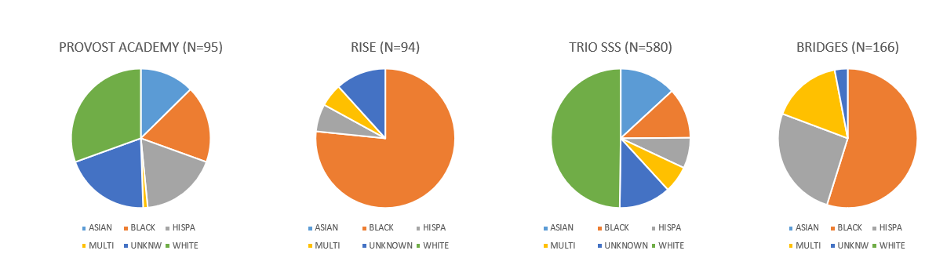
Participation landscape: Black (38%) and Hispanic (19%) students participated in support programs at substantially higher rates than Asian (4%) and White (2%) students, reflecting the programs' intentional focus on underrepresented populations.
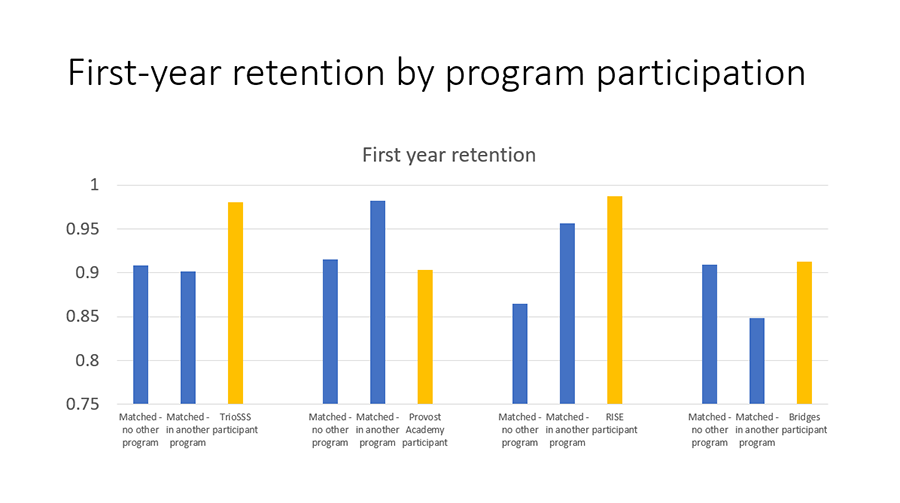
Retention benefits: Across all four programs, participation was associated with higher first-year retention compared to matched control groups. This positive association held across URM and Pell-eligible subgroups.
Per-program analysis: When examined individually, all four programs showed positive associations with retention relative to two matched control groups (no program participation and participation in a different program). This suggests that the retention benefits are not limited to any single program model.
Implications
These programs serve as laboratories for understanding what works when we invest deeply in students who face the greatest barriers. The question that drives ongoing work is: what can we learn from these intensive models that could inform how we support all students? How do we scale the insights without losing the combination that makes them effective — advising, mentoring, community, high expectations, and sustained attention?
Key People: April Belback, Leo Schumann, Amanda Brodish