
Status: ACTIVE
Priority Area: Psychology of Student Success
Population: Incoming first-year undergraduates; incoming graduate and professional students
Delivery: Online pre-matriculation activity (30 minutes)
Mechanism: Social belonging, attributional reframing
For most students, attending a major research university marks a major life transition. Many move away from home for the first time, take classes that are larger and more challenging than what they are accustomed to, and form entirely new social networks. This transition can be exciting, but it can also be stressful, lonely, and confusing. And the stress is not felt equally: students from historically marginalized and excluded populations tend to experience higher levels of transitional uncertainty.
The Pitt Transition Study (PTS) is a brief online activity that incoming students complete before arriving on campus. Through the activity, students learn that doubts about the transition to college are normal, that adversity during the transition (feeling homesick, anonymous, uncertain) is common and likely to be temporary, and that successful students have navigated these same challenges.
Launched in 2019 as part of the College Transition Collaborative (now the Equity Accelerator), the PTS has reached over 3,300 students annually and has been extended to incoming graduate and professional students since 2021.
Key Findings
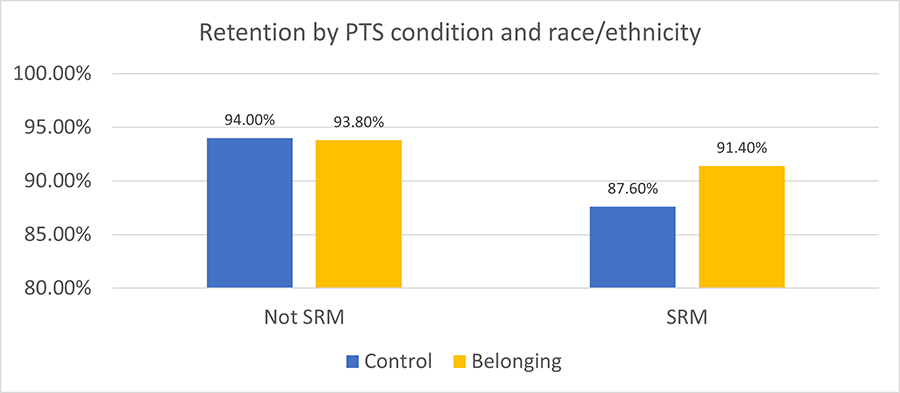
From 2019 to 2021 (randomized controlled design), the PTS demonstrated that the belonging activity improved first-year retention overall (control: 90.8%, belonging: 92.6%), with the greatest benefits among stereotyped racial minority students. Students who completed the activity also earned higher first-year GPAs, reported greater excitement about attending Pitt, and anticipated more difficulty during the transition—suggesting the activity prepared students for challenge rather than minimizing it.
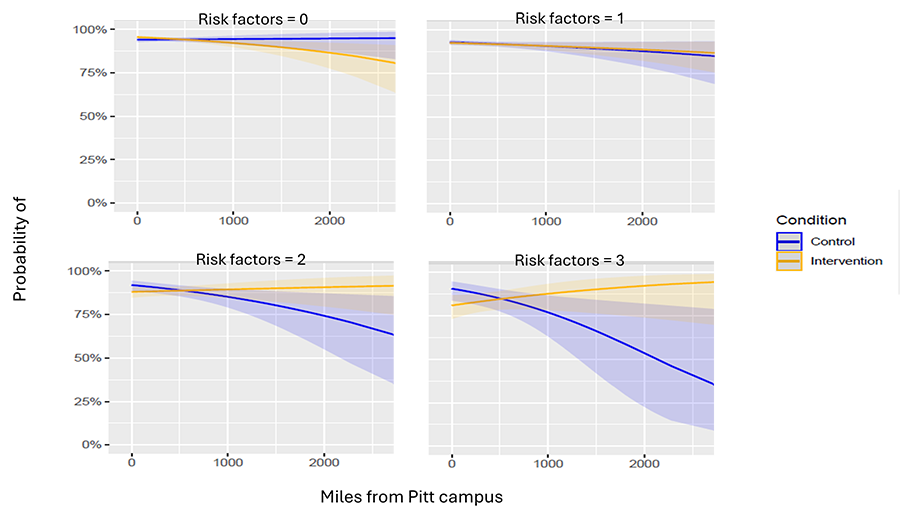
Moderator analyses found that the intervention was especially impactful for students with multiple demographic risk factors (SRM status, Pell eligibility, first-generation) who traveled long distances to attend Pitt. The intervention was not needed among students who joined campus diversity organizations or who lived near campus before matriculating.
The Graduate Transition Survey, launched in 2021, has largely replicated these retention benefits among graduate and professional students, particularly for Black, Latinx, and Indigenous students.
Data Visualizations
Publications
- Binning, K. R., et al. (2020). Ecological belonging. Psychol Sci.
- Walton, G. M. et al. (2023). Where and with whom does a brief social-belonging intervention promote progress in college? Science.
Key People: Kevin Binning, Leo Schumann