
Status: ACTIVE
Priority Area: Psychology of Student Success
Population: Incoming first-year undergraduates; incoming graduate and professional students
Delivery: Online pre-matriculation activity (30 minutes)
Mechanism: Social belonging, attributional reframing
Key Findings
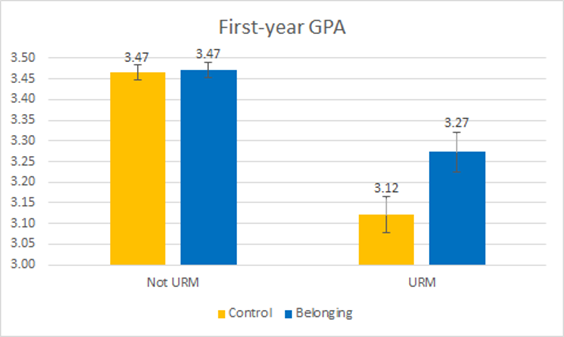
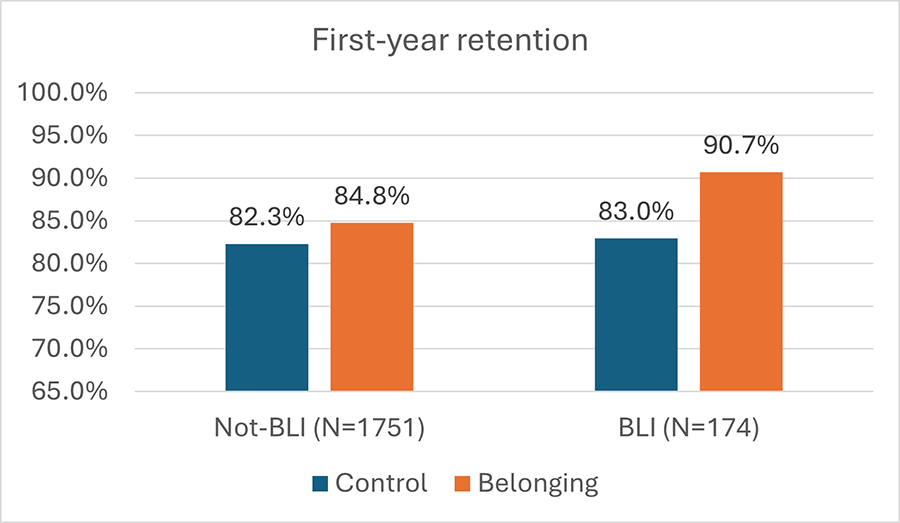
Beginning in the fall of 2021, we adapted and launched the study for matriculating graduate and professional students at Pitt. Although data analysis is in its early stages, thus far we have largely replicated the retention benefits seen in the undergrad-facing PTS mentioned above. The figure below is based on data from the 2021 and 2022 participants who are identified as Black, Latinx, and Indigenous (BLI) and not.
As shown in the second figure below, recruitment efforts for the GTS have consistently yielded a sample consisting of 35-36% of the matriculating class each term.
Data Visualizations
Publications
- Binning, K. R., et al. (2020). Ecological belonging. Psychol Sci.
Walton, G. M. et al. (2023). Where and with whom does a brief social-belonging intervention promote progress in college? Science.
Key People: Kevin Binning, Leo Schumann